
This is software (AWS) generated transcription and it is not perfect.
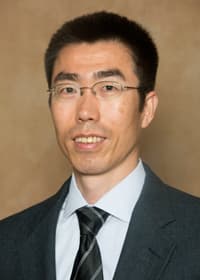
I came from China, in Shandong province. That's my hometown. I went to UT Austin to study my PhD and then I've been living in Lexington, Kentucky and then now Minneapolis. So, in my life, I enjoy playing badminton and I also enjoy watching some movies. And thank you for this opportunity. I'll be happy to share my thoughts.
Wonderful. So, we have MIS undergraduate program. As you can imagine the students learning this programs, they learn the foundations of information systems. They learn programming and database. They also learn information security and analytics. So, our students go to different kinds of jobs. Some go on to do IT consultants. Some students will get a job in IT security or they may do a project management information system development and they maybe do data analyst. So, these are the common jobs that they get. I know more about our master program. So, this is master of science in business analytics. In this one-year program, they learn many things about analytics. We go breadth and depth on many subjects. So, they learn things like predictive analytics, explorative analytics, digital experiments, forecasting and big data. So, we basically give them all around experience and learning experience in doing business analytics. So, the jobs they tend to get after graduation, I think, are interesting. Analytics jobs are industry agnostic. So, we keep seeing them going to different kinds of industries. Some go to doing consulting and some go for financial industries and retail like the likes of Walmart and Target. They also go to IT companies. We have Amazon, we have Google, and we also have other industries, maybe some entertainment and some nonprofits. So, the kind of job titles tend to be data scientist, data analyst, and IT consultant. Those are the typical job titles that they're getting.
In our case, I think I would encourage students to take the program based on the quality of the faculty. We have a very stellar faculty and a lot of faculty that could do research in these areas. And I think also the quality of the program. I think that's what they're getting, right? So, I think they should look into the design of the program which we are very proud of that we provide kind of a systematic lockstep experience to our students. One of the things that is big attraction is our experiential learning components. So, we basically have experiential learning each semester. This is actually pretty important for students who may just came out of school or who have very limited analytics experiences so far. So, through this experiential learning, they can basically have these real world experience which they can bring to their job interviews and bring to their future jobs which allows them to actually grow very quickly through these things. I think those are the things that I encourage students to find out and and take into account. In terms of the misconceptions, I would say that I noticed a pattern the students somehow think that by doing analytics, they think about doing a Kaggle competition type where their job is to do only predictive analytics or doing some prediction and doing some machine learning. I think analytics is much broader than that. For example, you have to do data cleaning, you have to understand the question, you've to translate the question to analytics problem. You also need to do all kinds of analytics not only the predictive and exploratory. Sometimes, we do optimizing and some data engineering. So, we learned all that from our experiential learning product. It's really a wide range of topics and they all fall under the umbrella of analytics. I think that the misconception there is it's broader and they should be prepared to have all around training in the sub areas to be good at analytics.