
This is software (AWS) generated transcription and it is not perfect.
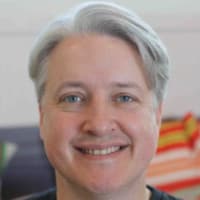
My base story is that I'm a native Coastal Californian, so I grew up in Southern California and most of my family was cops and soldiers, growing up and generally sort of blue-collar. I got a job in a hospital as a teenager, and then went to night school while in high school and became a paramedic. Got into UCLA as a chemistry major. Worked full time on the weekends, as a paramedic at the same time. Started out pre-med, and did a bachelor's and master's degree in chemistry at UCLA. Then I went down to San Diego to go to a medical school into a Ph.D., finished that up with a PhD in pathology, but in that process found myself using computers more and more as a scientist and headed into the field of science. You'd sort of call system biology, well, basically system biology. But I started doing, sort of more large scale computational things. And then, along the way did a couple of startups in the biotechnology and pharmaceutical space that we spun out of the lab. And then, for some weird reason found myself doing more of a cloud start-up in 2004 named Joint. Ended up leaving academia to do that full time, did that for a decade. We exited it out to private equity and then sold it off to Samsung at one point, in there, but started off my career as a scientist and then ended up, along that path being pretty entrepreneurial, then started doing other companies and other spaces like that, made another move into sort of the telco space if you will. And now I currently, Romo was a wholly-owned subsidiary of Deutsche Telecom. So it's known in the US. as T-mobile. But that's the base of the story. Started as a scientist, which really was the beginning of being an entrepreneur and an executive. And then now I'm just sort of a general-purpose entrepreneur and executive, across whatever field works basically and I guess the incidents and experiences for me, that shaped that path was just, I just always had to work, so always had to show up, always had to work. Always had to engage with people in a certain way and then had some great bosses along the way and mentors, sort of in that. I mean, for me, it was really sort of critical. The critical part of it was essential, who I had worked for along that path.
Well, for me, and I have two jobs in the current role. I'm the chair of the board and I'm also the CEO of the company, so I'm in an operational role as well. The chair role is around just the corporate governance aspects of the company. The company's owned by Deutsche Telekom, Samsung, VMware, these guys are on the board. So I have, basically owners of the company whose annual revenue adds up to, like, $800 billion a year. So there's a lot of shareholder management if you will. But I do that largely from sort of the chairman type role, and then just sort of organizing what the other board members need to do. But most importantly, what they need to do with each other as well because a big part there is, what are the sort of doing from a strategy standpoint and everything else, so, a big part of what I do is on the corporate governance side of things in the chair role. On the CEO job, CEO jobs, are, in some ways very lonely jobs. I don't know if I would sort of describing it that way, but you don't have a lot of responsibilities at the end of the day, you have a team that you've delegated quite a bit to. In that, there are a set of things, the way I tend to think about is, my team is usually, informing me about how things are going, educating me about a given thing in the space. So I spend a decent chunk of my time being informed and being educated by people. Another part of it is, occasionally, there are problems that only I can solve. I try to keep those set of problems, the smallest possible and try to fundamentally sort of fixing them, and then, of course, there are some decisions that have to be made, but most of the decisions are really around, what do we need to do to ensure the financial sustainability of the company? And really, what do we invest in? So I think the uppermost level when you look at, what responsibility, decisions I handle on a regular basis is I try to make a few high-quality decisions as possible around what really is our investment areas. And then who are the people that are going to be responsible for these areas? I mean, that's really it. And for me, the role of a CEO is really to ensure the financial sustainability of a company, like how are we? And then that goes, of course, that touches every dimension of the company in there. Yeah, for my weekly work hours. Now there's not a lot of travel because, of course, what's going on with the viral pandemic. I'd say that normally 25 to 50% of my time was travel, but that's gotten replaced quite a bit with video conferences instead. I mean, my work hours are very strange just because I run a company that's based out of the West Coast of the United States. So we're having technically headquartered out of San Francisco, but my owners are in Silicon Valley, in Germany, in Korea, and so on like that. So I have this 9 a.m. to 5 p.m. Window where I do US-based things, which is largely talking to my own team and other people in the company. Sort of what's going on there. Customers and the like. Then I have this sort of 4 p.m. to 2 a.m. window where meetings with Korea happen. And then I have this like, 11 p.m. to 9 a.m. window were meetings with Germany and the Middle East. happen. Sometimes I end up having 3 6-hour days on each major sort of time zone shift. But it's an ok tradeoff for not traveling in many ways because when you travel, I mean, I would have to do San Francisco to Frankfurt and Frankfurt to Seoul and Seoul to home. And you could spend 30-40 hours on an airplane in a week, plus everything you're doing on top of that, in that week. It's OK.
The biggest challenge for me is and I think for most people in this is really, like a lot of the engineering and economic aspects of how you set up a certain financial structure of the company and so on, like that's relatively straight forward, once you sort of learn it. A lot of it is, dealing with the psychology of other people. Really sort of helping motivate them. Probably the biggest challenge is how are people feeling that worked for me? How are people feeling that worked for them? How are people working together or not? Probably the biggest competitive issue we have in our space, which is really sort of the technical space is that there are a lot of really rich technology companies around and compensation around certain key roles gets really, really challenging, in the sense of, it's practically impossible to hire certain expertise in machine learning and stuff like that, for example, because they're getting yanked right out of a Ph.D. program by Google and getting paid $12 million and then, how do you explain that to somebody who runs a telecom in Germany and somebody who goes and manufacturers chips in Korea that this one individual is worth that much and so a lot of the challenges right now, I think in that is exactly around, the big disconnect between the size of a company, the compensation structure of certain talent and really sort of what that talent really does for what the company tries to do right. But that's the biggest challenge is really sort of how to invest in people and sort of that competitive investing environment many ways when you compare it to big companies.