
This is software (AWS) generated transcription and it is not perfect.
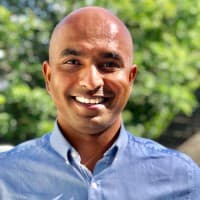
eso. I've been in the energy industry for about 15 years, so it's certainly, you know, it's Zaken me 15 years to get to what I am. Uh, and my story is is, you know, something that's very common in the industry. I'm an engineer who just was fascinated with building a business, and I worked for a couple of years in India for IBM and emphasis. And then I moved to graduate school at the University of Utah, where my first break from technology to energy industry was actually working for the then Jon Huntsman, the governor of Utah, under a program called Utah Science, Technology and Research, where I had a chance Thio work closely with his energy adviser, Laura Nelson, and really get exposed. Thio. What at that point was, ah, big push in Utah towards exploring alternative energy. Resource is so geothermal solar in southern Utah, eso worked. Did a couple internships with Rocky Mountain Power. That was my first break into energy industry, and since then I've had been very fortunate to work across the entire breath of the energy industry. Even though I started on the clean energy side, I did move to island gas where I worked with research group card E G I, uh, rose through the ranks. I was there for almost a decade on day as I was appointed as the chief technology officer of E G. Essentially, they're the oil and gas industry. Gave me exposure. Um, Thio, You know what A what a huge effort it takes to keep the global economy moving way as an economy consume 100 million barrels of oil every day, we got to explore, find that oil and refine it and ship it and use ESO is one of the most fascinating supply chains in the industry, and I sort of had to go do that to realize and spun out of company Did that for a few years on. Then five years ago, we found out we were pregnant and my daughter was being born. And at the same time, oil price went down to $29 a barrel s a lot of things happened, and really, it was it was a point of reflection in my career. I wanted Thio be part of the solution and I wanted thio sort of helped build the energy transition. Eso it took me a few years. From that point forward, a lot of exploration. Thio finally land a position with N G i N G. Hired me, which is one of the world's largest independent power producers. They also had an oil and gas history. But as of 2018 they're fully divested from Goal coal. They're fully committed to renewables. And today, at N. G. I lead their digital initiatives that fall under what we call a zero carbon platform. Eso Really again, it's a 15 year journey. Ah, a lot of personal incidents on learning experiences have shaped my career path. Um and you know, I think I think it was a little bit of persistence, but a lot of it was being in the right place the right time. Uh, it's a good balance of both.
Yeah s Oh, that was my role until December of last year. As of this year, I have a new role. I am now the head of zero Carbon platform for energy group. Um, but I'll touch on the roles and responsibilities in my new role. Um, what I do is I oversee our digital ecosystem that supports in these global customers in helping them understand how to measure and monitor their progress. The words publicly committed goals. We work with the companies that everybody's heard off. We work with. Over 35% of the Fortune 500 organizations on energy is a committed the carbon ization partner for many of these organizations. So my responsibilities are either run the end to end business offering for the carbon ization that includes support from the digital platform. Eso We have multiple product modules within that we have a product module that helps companies optimize their supply decisions. So these air electricity supply contracts, both on site and off site are parties, agreements on site, solar storage in and other forms of energy. Um, there's also good environment. Where N G is a service company offers energy retrofits and energy efficiency eso. That's another responsibility on an up and coming area for N. G through our sister company TV boxes, fleet electrification and electric charging infrastructure. Eso My role is broad. The responsibilities are simple. It is to help make sure that our customers have an enterprise product that is up on available 24 7 to help navigate their decolonization journey. Um, the decisions that I get to make largely as I have a 30 person team. Uh, here, however, a lot of work that I do is is energies of very matrix organization s, even though I have a small team, Well, 30 isn't a small, but it is a small team when you work for 180,000 people. Company um, we do a lot of work across and in a matrix organization. Um, in the decisions are primarily a combination off. The biggest decisions that I have to make is building the team and hiding decisions on. I do have support from, ah, lot of other key leaders from my team technology decisions, eh? So it's a combination of business and technology. A lot of these are technical choices. Who would be partner with what are the pricing decisions that we need to make. Which customers are we going? Thio work with the release beta version of a product on How do we think about scaling Ng's partnerships to broader global offerings? Weekly work hours are you know, they're they're all over the place, certainly in a pre code word we had, we had a bit more certainty, But one of the nice things if remote work is I probably used to spend 100 102 150 hour days. Ah, year on travel all around the world. Anti operates in 60 different countries and we have customers all over the world this year. Uh, that has been obviously put to arrest. I haven't gotten on a plane since March, which is good for the family. Uh, but you know, that's the new reality that we're all living in. Um, so traditionally, my time was spent about 30 to 30 to 40% of my time was spent on travel. And just because I have teams out all around the world, but now everybody switch Thio, switch thio remote and there are some good days and bad days. If trying to coordinate a global team and across multiple time zones. So it z certainly this'll current phase is an anomaly right now. Yes, everybody on my team, including myself, were always on call. Try to break things away and, you know, But but But they're certainly long, you know, 60 70 hour weeks or normal. Uh, that Z Like I said, it's an anomaly, Uh, where everybody's trying to get through the current, uh, bump in the road.just, you know primarily, uh, off working, working, remote are you know, they're still new? Eso Everybody is trying to figure out how toe rewire their professional lives and work around.
Yeah, One of the biggest challenges in my job is balancing speed to market with the ability to scale products across the globe. Obviously, when you when you work with customers that have a global footprint we work with, like I said, 35% of the Fortune 500 organizations These range from a retail organizations, automotive, industrial manufacturers, um, in and a big challenge is digital isn't really necessarily a solution to all of that happens in the physical world, particularly from a d carbon ization standpoint. Ah, lot of the challenges are centered around just how fragmented the energy industry is. You know, as an example, if you're ah, Google or in A T and T or any other energies customers, it is not a one size fits all when it comes to your energy strategy, because the energy markets a very diverse, particularly when it comes to purchasing electricity and natural gas. Eso the challenges are really trying to navigate a very diverse regulatory environment across the world that somewhat, uh, non homogeneous or heterogeneous in many ways, um, and many of the approaches in dealing with these challenges is really having to rely on building local expertise having teams that understand bringing in experts that really have subject matter knowledge in local energy markets. Onda having them work alongside technology teams has been a plus. Um, I think you know, there, there, maybe maybe one or two examples that I can share from my personal experience is of course, you know, having an open mind. And, you know, working as a team becomes very important, you know, for for students. And I recollect, 15 years ago, when I started, uh, it took me a few years. Thio really switch my thinking on how you go from being an individual contributor, uh, to do a team player on. I think sooner the students can actually switch to that mindset where you know, you learn how toe put communication methodologies in place, how to build a team, how toe work with the team, how to be a team player. I think those are all specific examples that, you know, I perhaps could have done better. I could have started earlier in my career to switch the perspective of approaching problems from rather than an individualistic mindset. You know, bring a team mindset because it is not it is almost impossible. Uh, Thio Thio have all the expertise or to build all of the expertise that is required thio to solve complex challenges. Of course, it depends on every industry, Uh, in some industries, you know, having having the ability to develop that skill set is a plus. In some industries, you almost especially in the energy industry. You almost don't want to become an expert because then you, you know, with that comes all the dogmas and and preconceived notions eso you really want to work with, people that have very levels of expertise and knowledge on very levels of creativity and problem solving skills that they could bring to the table. Eso I think from my perspective, a few examples that have helped me learn better is to have an open mind on and Thio really leave behind all of the preconceived notions and come to the table as much as possible every day with the mindset that there's something that I can learn from the people that I work with and that Zatz worked really well on day. I wish had adopted that model mental model sooner in my career.